Number 823 - Transvision Vamp
Labels: Transvision Vamp
The Definitive 1000 Songs Of All Time 1955 to 2005
Counting down to the Number 1 Song Of All Time! On screen is the latest song added to the Top 1000. This is a "Work in Progress" so be patient.. please! (Ok.. Moan, what the hell)
Labels: Transvision Vamp


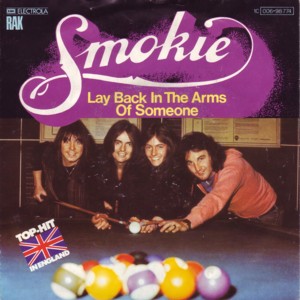
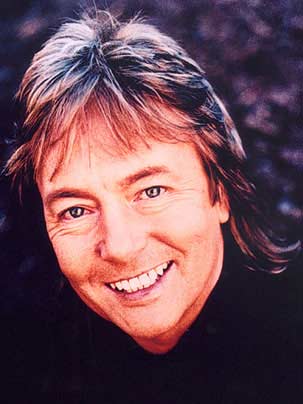
"Originally formed in Yorkshire, England, in 1966, Smokie hit the British pop charts several times during the late '70s with updated psychedelic pop, influenced by the band's stay on Mickie Most's Rak Records as well as the writers of most of the band's hit material, Rak's Nicky Chinn and Mike Chapman. Vocalist Chris Norman, guitarist Terry Utley, and bassist Alan Silson had played in the Elizabethans, but formed the band Kindness in 1968, with the addition of drummer Pete Spencer. The quartet recorded many singles during the late '60s and early '70s, but failed to show any chart activity until 1975. That year, signed to Rak Records and billed as Smokey, the band hit number three in the U.K. with "If You Think You Know How to Love Me." After another Top Ten hit, "Don't Play Your Rock 'N Roll to Me," Smokey became Smokie; during 1976, the group scored with three Top 20 hits, including the number-five "Living Next Door to Alice." Smokie hit number five both in 1977 ("It's Your Life") and 1978 ("Oh Carol"), but the band's chart run ended by early 1980, and following 1982's Midnight Delight, they disbanded. Both Spencer and Norman continued to work at Rak during the '80s, writing hits for several groups; they reformed Smokie in 1988, resurfacing with the LP My Heart Is True. Two more albums, All Fired Up and Greatest Hits Live, followed a year later, with the group remaining active throughout the 1990s, issuing new material as well as a number of hits collections"
Labels: Smokie

Number 822
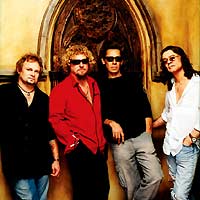
The power struggle within Van Halen was often painted as David Lee Roth's ego running out of control -- a theory that was easy enough to believe given his outsized charisma -- but in retrospect, it seems evident that Eddie Van Halen wanted respect to go along with his gargantuan fame, and Roth wasn't willing to play. Bizarrely enough, Sammy Hagar -- the former Montrose lead singer who had carved out a successful solo career -- was ready to play, possibly because the Red Rocker was never afraid of being earnest, nor was he afraid of synthesizers, for that matter. There was always the lingering suspicion that, yes, Sammy truly couldn't drive 55, and that's why he wrote the song, and that kind of forthright rocking is evident on the strident anthems of 5150. From the moment the album opens with the crashing "Good Enough," it's clearly the work of the same band -- it's hard to mistake Eddie's guitars, just as it's hard to mistake Alex and Michael Anthony's pulse, or Michael's harmonies -- but the music feels decidedly different. Where Diamond Dave would have strutted through the song with his tongue firmly in cheek, Hagar plays it right down the middle, never winking, never joking. Even when he takes a stab at humor on the closing "Inside" -- joshing around about why the guys chose him as a replacement -- it never feels funny, probably because, unlike Dave, he's not a born comedian.
Then again, 5150 wasn't really intended to be funny; it was intended to be a serious album, spiked by a few relentless metallic rockers like "Get Up," but functioning more as a vehicle to showcase Van Halen's -- particularly the guitarist's -- increasing growth and maturity. There are plenty of power ballads, in "Why Can't This Be Love" and "Love Walks In," there's a soaring anthem of inspiration in "Dreams," and even the straight-up rocker "Best of Both Worlds" is tighter and leaner than the gonzo excursions of "Panama" and "Hot for Teacher." And that's where Hagar comes in: Diamond Dave didn't have much patience for plainspoken lyrics or crafting songs, but Sammy does and he brings a previously unheard sense of discipline to the writing on 5150. Not that Hagar is a craftsman like Randy Newman, but he's helped push Van Halen into a dedication on writing full-fledged songs, something that often seemed an afterthought in the original lineup. And so Van Hagar was a bit of an odd mix -- a party band and a party guy, slowly veering into a bourgeois concept of respectability, something that eventually sunk the band -- but on 5150 it worked because they had the songs and the desire to party, so those good intentions and slow tunes don't slow the album down; they give it variety and help make the album a pretty impressive opening act for Van Halen Mach II. ~ [Stephen Thomas Erlewine, All Music Guide]
What does RS think?
Labels: Van Halen 822